
Key Takeaways
- A policy rewrite may not improve unemployment outcomes if inconsistent execution—not the policy language—is the real issue.
- The final incident can carry significant weight, including the employee’s reason for the absence, awareness of the consequences, and control over the circumstances.
- Clear expectations, signed acknowledgements, progressive discipline, consistent enforcement, and complete documentation can strengthen an employer’s position.
- Exceptions and potential good-cause circumstances should be evaluated consistently and documented thoroughly.
- SHIELD Analytics can provide data that reveals patterns by manager, location, shift, or process step, helping employers target coaching and controls before overhauling the policy.
Attendance-based claims can cause a lot of frustration for employers because they seem so simple on the surface: employees are assigned shifts, and they should show up for those shifts. Case closed, right? Not quite.
In reality, attendance claims are complicated by layers of nuance that can be hard to understand and even harder to explain after a separation. The policy itself matters, but so does the system behind it, the final incident, the employee’s reason for missing work, the consistency of enforcement, and the quality of the documentation. Before you overhaul your policy, it helps to ask the right questions.
Frequently Asked Questions
Are you looking closely enough at the final incident?
This is where many attendance cases take an unexpected turn. State agencies often focus heavily on the final incident that triggered the separation. They may ask whether the employee had good cause for that specific absence, such as a genuine emergency or illness, even when the attendance record shows a long pattern of problems.
That means the last absence is not merely the final line in a spreadsheet. It may be the centerpiece of the claim. Did the employee follow the call-off procedure? Was the reason investigated? Was supporting information requested and reviewed? Was the termination decision tied to the policy violation rather than simply the existence of an absence? A strong record answers those questions before an agency has to ask.
Even with thorough documentation, it is possible to still receive an unfavorable determination because the outcome may turn on more than the employer’s records; it may hinge on the employee’s state of mind. What we mean by that is did the employee know that their actions on the final incident would cause their separation? Secondly, did the employee have control over their actions that led to separation? Agencies often consider whether the employee knew the final incident could very well result in termination and whether the conduct was within the employee’s control. If the employee did not knowingly or deliberately disregard the employer’s expectations, or lacked control over the circumstances, the conduct may result in an unfavorable decision for the employer because the employees actions did not rise to the level of willful, deliberate work-related misconduct. In other words, what the employee understood, intended, and chose to do can directly influence the final decision and/or a deliberate disregard to the employer’s best interest.
Should I change my attendance policy to improve my unemployment win rates?
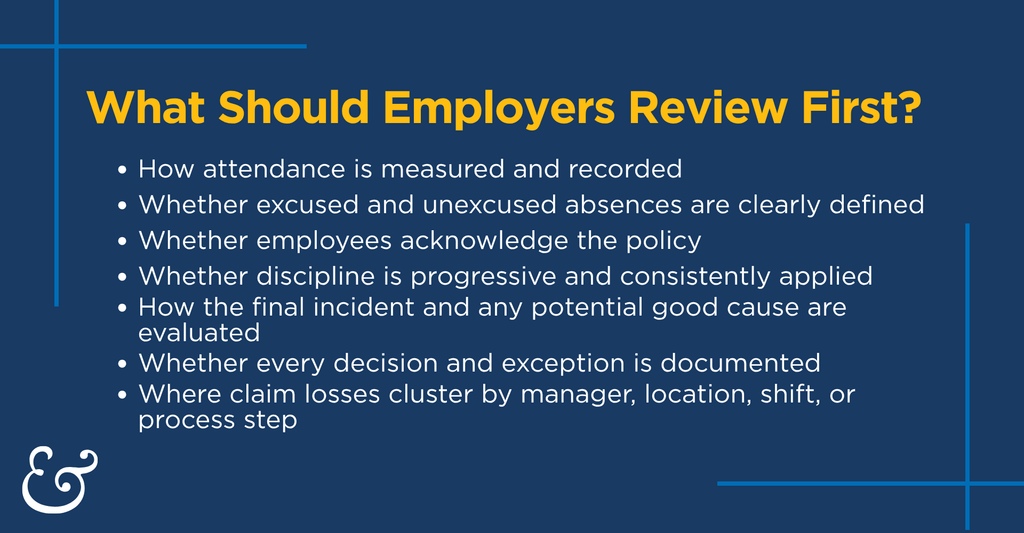
Maybe—but not so fast. A policy rewrite can be a major undertaking. It may require legal review, updated systems, manager training, new communications, signed acknowledgements, and careful adherence to state laws. If inconsistent enforcement, not the policy language, is driving unfavorable outcomes, a wholesale rewrite may create more work without solving the real problem.
Have you clearly defined acceptable absenteeism?
Employees should know what counts as an excused absence, what documentation may be required, how and when to report an absence, and what happens when the rules are not followed. Ambiguity is rarely your friend in an unemployment claim. Clear definitions help establish that the employee knew the expectations and that the employer applied them as written.
Do you require signed acknowledgements?
A well-written policy is only helpful if you can show that the employee received it. Signed or electronic acknowledgements, records of policy updates, and proof of relevant training can strengthen the story your documentation tells. Think of the acknowledgement as the receipt: without it, proving the employee understood the rules becomes much harder.
Is the discipline progressive?
Progressive discipline can demonstrate that the employee had opportunities to correct the behavior and understood that continued violations could lead to termination. Verbal warning, written warning, final warning, then separation: the labels may vary, but the sequence should be clear, supported, and consistent. Skipping steps without a documented reason can turn an apparently straightforward case into a much tougher one.
Do you uniformly enforce your policy?
Consistency can make or break an attendance case. If similar conduct produces different consequences across locations, departments, shifts, or managers, the policy may look more like a suggestion than a standard. Exceptions may be appropriate, but they should be grounded in legitimate circumstances and documented. Otherwise, your “clear-cut” attendance case can quickly become a debate about uneven treatment.
Do you document every step of the process?
Good documentation should show more than dates and points. It should capture each incident, including the reason provided, the manager’s follow-up, the discipline issued, and the employee’s response, along with the applicable policy and the employee’s acknowledgement. If an exception was made, document why. If the final incident involved an emergency or illness, document what was considered. In unemployment claims, the details that felt obvious at the time are often the details everyone struggles to reconstruct later.
Have you evaluated the underlying claims data?
Before launching the policy-rewrite parade (legal review, process redesign, system changes, training, acknowledgements, and communications) pause and examine what your claims data is actually telling you. Are losses concentrated under certain managers, locations, or shifts? Are warnings missing? Are separations happening before progressive discipline is complete? Are final incidents involving potential good cause being handled inconsistently?
If the written policy is sound but the execution varies, changing the policy may simply give you a newer policy to enforce inconsistently. The more effective move may be targeted manager coaching, stronger documentation controls, clearer escalation points, or better oversight of exceptions.
How can SHIELD Analytics help?
SHIELD Analytics—named a 2026 Top HR Product of the Year by HR Executive and HR Tech—can help uncover trends in your unemployment data that may serve as leading indicators of an enforcement problem. By identifying patterns across locations, managers, claim outcomes, and separation practices, analytics can help you see where the policy may be breaking down in practice before you commit to wholesale changes on paper.
The bottom line: Better unemployment outcomes do not always begin with a better attendance policy. Sometimes they begin with better visibility, more consistent enforcement, and documentation that tells the whole story. Before you rewrite the rulebook, make sure the real issue is not how the game is being called.